
Nitrogen Pumping
Nitrogen Pumping
The Service
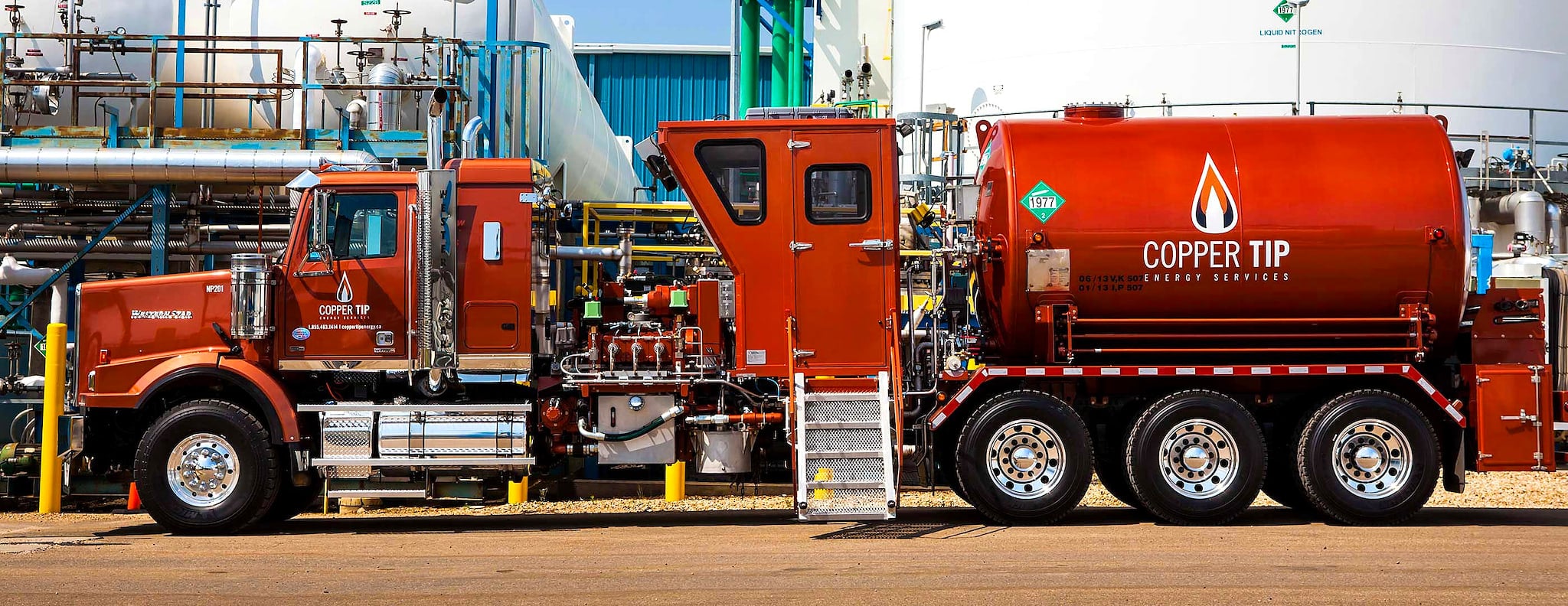
Copper Tip Energy Services operates one of the most capable nitrogen pumping fleets in North America, with both flameless and direct-fired units available for a wide range of oilfield, pipeline, and process applications.
Our nitrogen units feature automated control systems that improve job safety, reduce operator error, and accelerate job completion, a key differentiator in time-sensitive operations.
Whether the application is a simple nitrogen lift, a pressure test on a pipeline, or a complex foam cement job, our crews have the equipment and expertise to deliver.
Equipment
Applications
What We Do
Pipeline Purging
- Product displacement for line maintenance
- Pipeline Inspection Run (ILI) support
- Purge and pack for line fill
- Purge and blanket for decommissioning
- Line drying
- Leak detection
Facility & Plant Turnaround Support
- Hot nitrogen for reactor cooldowns and pre-heating for startup
- Low rate / low pressure inerting during catalyst change-out
- LEL-free atmospheres for maintenance activities
- O₂-free environments for startup
- Vessel purging, inerting, and long-term storage blanketing
- Leak detection
Nitrogen Kick-Around: Well Lifting & Unloading
- Restoring production on loaded or killed wells
- Post-stimulation unloading
- Coiled tubing-assisted nitrogen lift
Nitrified Wellbore Fracturing
- Nitrogen-energized fracturing fluid to improve fluid recovery
- Reduces hydrostatic load on low-pressure formations
- Enhances flowback in water-sensitive reservoirs
Nitrified Wellbore Stimulation
- Nitrogen used to energize stimulation fluids
- Boosts natural flow rates post-treatment
- Applied in acid stimulations and matrix jobs
Nitrogen Pumping
Service
You Can Count On
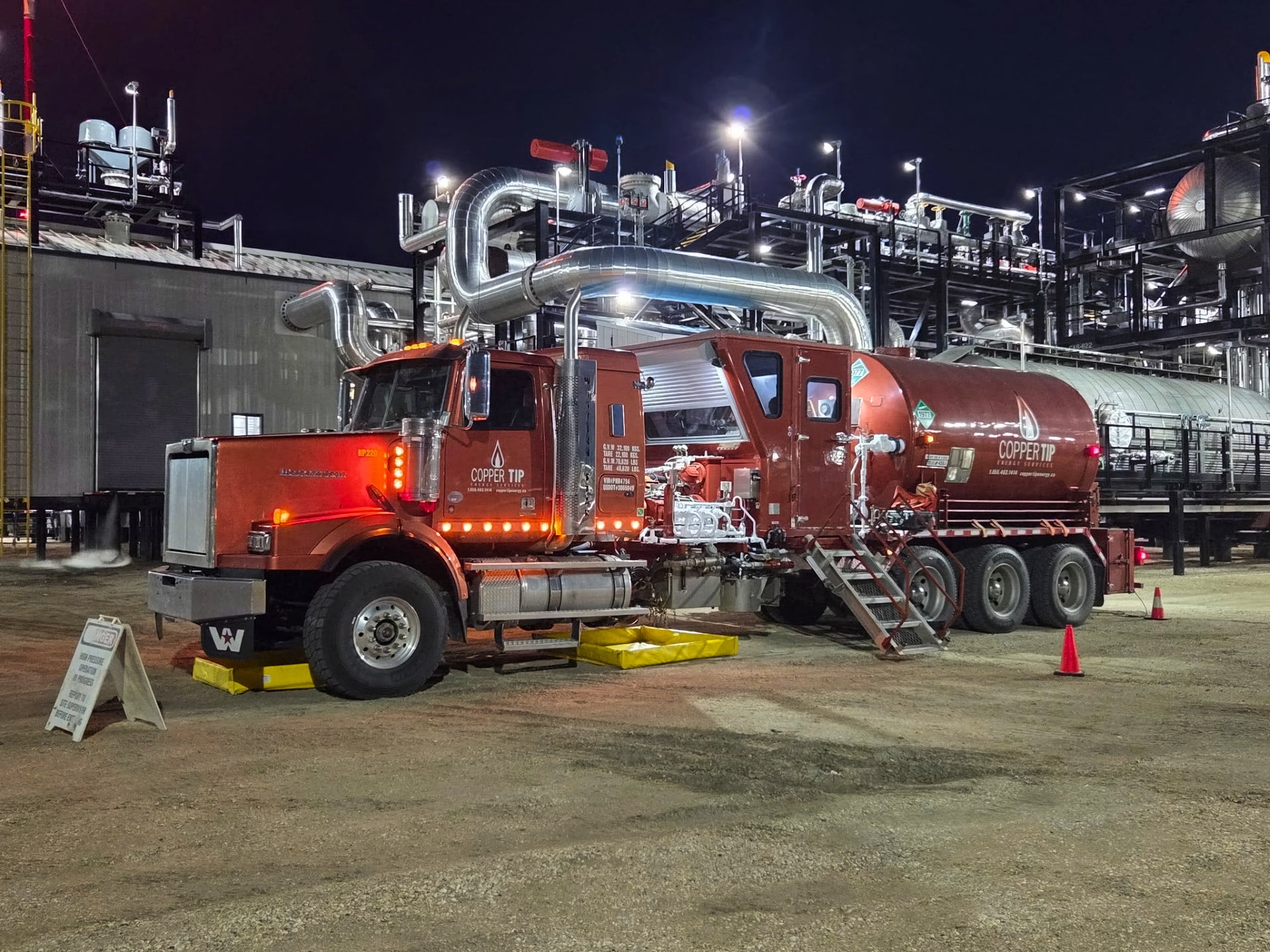
Our crews and equipment are available around the clock across Canada and the United States.
Equipment & Operations
Where We Work
Basins & Regions
Understanding the Service
What is Nitrogen Pumping?
Nitrogen pumping converts liquid nitrogen (LN₂) into high-pressure gaseous nitrogen (N₂) for injection into wells, pipelines, and process facilities. As an inert, dry, and non-reactive gas, nitrogen is one of the most versatile tools in oilfield operations, used for well stimulation, pipeline purging, pressure testing, and facility commissioning.
Copper Tip operates both flameless and direct-fired nitrogen pumping units. Flameless units are required in enclosed facilities and locations where open flame is restricted, making them ideal for plant turnarounds, compressor stations, and confined environments. Direct-fired units deliver high-volume nitrogen at sustained flow rates for large-scale pipeline and wellbore applications.
Nitrogen service is available 24 hours a day from our 11 locations across Western Canada and the United States, with crews experienced in single-well operations, multi-unit co-ordination, and integrated coiled tubing support.
Common Questions
What is nitrogen pumping in oil and gas?
Nitrogen pumping converts liquid nitrogen (LN₂) into high-pressure gaseous nitrogen (N₂) for injection into wells, pipelines, and process facilities. Nitrogen is inert, dry, and non-reactive, making it safe for use in environments where flammable gases are present. It is used for well lift and unloading, pipeline pressure testing, vessel purging, facility commissioning, and hydrostatic testing.
What is the difference between flameless and direct-fired nitrogen pumping?
Flameless nitrogen pumping units use a hot water or electric heating system with no open flame, as required in enclosed facilities, compressor stations, and locations with flammable atmospheres. Direct-fired units use a burner to heat liquid nitrogen and are used for high-volume applications such as large-diameter pipeline flooding and sustained well treatments where flame restrictions do not apply.
What is nitrogen lift in oil and gas?
Nitrogen lift, also called nitrogen unloading, involves injecting nitrogen gas into a wellbore to reduce the hydrostatic pressure of the fluid column, allowing the well to flow naturally to surface. It is commonly used to restore production after a well kill, following a stimulation treatment, or when a well has loaded up with fluid and stopped producing.
What is nitrogen used for in pipeline commissioning?
In pipeline commissioning, nitrogen is used to purge oxygen and moisture from the line prior to introducing hydrocarbons, preventing corrosion and eliminating explosion risk. Nitrogen is also used for leak testing, pressure testing, and line drying during pre-commissioning and commissioning of new pipelines and processing facilities.